


Charcoal Snake Brisket Method Explained
Charcoal snake brisket demands patience, proving that slow cooking and time are the true secrets behind perfect results. A brisket, cut from the cow’s chest, is notoriously tough, and it needs long, slow cooking to transform into the juicy, melt-in-the-mouth meat that barbecue lovers crave. While brisket can intimidate even seasoned home cooks, the truth is that its perfection lies in a simple rule: keep it low and slow. Rushing the process leads to chewiness; pushing too far risks the meat falling apart into strands. The magic lies in steady, consistent heat over several hours.
For many, the ideal tool for this process is a smoker. However, not everyone has one tucked away in their garden shed. Fortunately, with the clever use of the snake method, even an ordinary kettle grill can mimic the conditions of a smoker and turn out brisket worthy of a barbecue competition.
What Charcoal Snake Brisket Method Involves?
 The snake method is a clever way of arranging charcoal or briquettes inside a kettle grill. Instead of spreading them evenly across the base and creating intense, short-lived heat, place the coals in a curved line – often shaped like a “C” – along the inside edge of the grill. Light the fire at just one end of this row, and let the flames slowly travel along the chain of briquettes.
This staggered ignition produces a controlled, gentle heat source that lasts far longer than simply dumping a pile of charcoal in the centre. It also makes the grill behave more like a smoker, where only part of the fuel is burning at any given time.
Champion pitmaster Christie Vanover, founder of Girls Can Grill and winner of multiple barbecue awards, swears by the method. She notes that it’s particularly effective in kettle-style grills, where the rounded shape promotes even circulation of heat.
Why Briquettes Beat Lump Charcoal
Although both lump charcoal and briquettes can fuel a barbecue, the snake method tends to favour the latter. Briquettes burn in a more predictable way, which is vital when trying to keep a steady temperature for hours on end. Their uniform size also makes it easier to build an even, structured “snake” of consistent thickness – usually three or four briquettes wide.
For added flavour, wood chips can be tucked in between sections of the snake. Hickory, oak, applewood, or cherry each bring their own distinctive notes to the brisket. However, restraint is key. Too much wood can spark multiple coals at once, sending the temperature soaring. Vanover recommends spacing the wood carefully and avoiding placing a single chip across more than one briquette.
Charcoal Snake Brisket and Temperature Control
The real skill in smoking brisket with the snake method lies in managing heat. A full snake can last around five hours, but for a brisket, which often requires eight hours or more, additional fuel will need to be added.
Vanover advises monitoring the grill’s temperature throughout the process. When you remove the brisket for wrapping, the meat stays protected in butcher paper or foil. At this stage, you should extend the snake with fresh coals. Push down the ash, continue the “C” shape, and keep the grill burning steadily without disruption.
Why the Snake Method Works for Brisket
The beauty of this method lies in its ability to mimic the gentle conditions of a smoker without specialist equipment. Traditional grills are designed for quick, high-heat cooking – ideal for steaks or burgers but disastrous for brisket. With the snake method, however, the flames creep slowly along the charcoal, keeping the temperature far lower and more manageable.
This consistency allows the brisket’s bark – the deeply flavoured, crunchy crust – to form properly without the risk of scorching. It also ensures the collagen within the meat breaks down gradually, leaving the brisket both tender and sliceable.
Charcoal Snake Brisket: Cooking by Feel
 Many barbecue methods, such as the “3-2-1” approach often used for ribs, rely heavily on timing. But brisket demands more intuition. Every cut of meat is slightly different, and the snake method can produce slightly higher temperatures than a dedicated smoker. For this reason, Vanover suggests judging progress by texture and appearance rather than sticking rigidly to the clock.
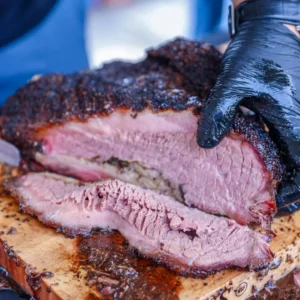
A good brisket will have a dark, mahogany bark, and when probed, the meat should offer little resistance. If it feels like sliding a knife into softened butter, it’s ready.
Beyond Brisket: Other Meats to Try
Although brisket is often the star of the show, the snake method is versatile enough for other slow-cooked favourites. Pork shoulder, destined for pulled pork, benefits enormously from the technique, developing rich, smoky flavours and tender meat that falls apart effortlessly. Ribs, too, take on a beautiful balance of bark and tenderness when cooked this way.
Essentially, any cut that thrives on long, slow heat will shine with the snake method.
Charcoal Snake Brisket Leftovers Made Simple
Smoking a whole brisket is no small task, and often results in far more meat than a household can eat in one sitting. Luckily, brisket is one of the most rewarding leftovers around. Thinly sliced brisket can elevate a sandwich or wrap, while chopped brisket stirs wonderfully into macaroni and cheese. For something more adventurous, it can even be folded into tacos or stirred through fried rice for a smoky twist.
Final Thoughts
The snake method might not be as widely known as other barbecue techniques, but it is a game-changer for home cooks without a smoker. With only briquettes, patience, and a kettle grill, you can create an incredible brisket. Moreover, it rivals professional pitmasters’ results.
The key is consistency – slow, measured burning that allows the meat to transform gradually. For those willing to invest the time, the reward is not just tender, flavourful brisket but also the satisfaction of mastering a time-honoured craft.